I was recently browsing the Chancery cases on the Library of Virginia's website when I came across a case in Page County titled Jno. B. Davis & Others vs. Thos. J. Davis & others. Among the surnmames listed as parties to the case was the name Maiden, so this caught my eye. A quick search at the family tree on Ancestry.com found that Thomas J. and John Barton Davis were brothers of Anna (or Anne) Elizabeth Davis, wife of John Tyler Maiden and my great-great-great grandmother! So, this was obviously a case that involved our family and was worth looking into. Luckily the Library of Virginia had scanned in all of the pages associated with this case, and I was able to find out all of the details of the case and a lot of new things about that branch of our family tree.
Monday, March 4, 2013

Friday, January 27, 2012
Lawson House
It has been a while since we've posted here. The flow of new information slowed down, we got busy and we unfortunately didn't keep up with the blog. Well, I'm going to try to do a better job of posting things from time to time.
I'm going to start with a new find related to John William Allen.
Today, I was searching the Library of Virginia site and came across a record for the Lawson House in the Virginia Historical Inventory. This collection was originally assembled by the Virginia Writer's Project, a part of the depression-era Works Progress Administration. It documented thousands of historic homes and sites across Virginia. You can search the collection here.
One of the entries in this collectino describes the Nick Lawson house. The location described in the pages below, matches that of John William Allen's homeplace. We also see that the owner and occupier of the house, as well as this report's informant, is listed as J. A. Allen. This would appear to be John Arthur, John William's son. The description of the house on page three also matches that of photos we have (see below). There is no doubt that we've found a record on the old Allen home.


So, we know this is the Allen home, so who was Nick Lawson?? As we've posted before, John William Allen purchased, in 1900, 166 acres of land in Greene County. A portion of that deed is listed here:
This Deed made this Oct 15, 1900 between F.M. McMullan [?] hereinafter
described of one part and John W. Allen of the other part. Whereas
said F.M. McMullan & R.S. Thomas [?] in the suit of H.S. Collier vs
Lawson in Greene Circuit Court in pursuant of the decree entered in
the said cause at Nov term 1894 of said court made public sale on
March 13, 1895 of the Martin Collier Home Place of 166 acres 2 roods
13 poles of land.

As you can see, the land that was purchased was called the Martin Collier homeplace. As it turns out, a Nicholas Lawson married a daughter, Texanna, of Martin Collier. The H. S. Collier mentioned in the deed is most likely Hudson S. Collier, a son of Martin Collier. Apparently there was an issue with the purchase or transfer of the land between Nicholas Lawson and Hudson Collier that allowed John Allen to purchase it.
Some more digging into Nicholas Collier reveals that is his full name was John Nicholas Lawson. He was born in 1841 in Rockingham County. As it turns out, the Lawsons were neighbors with the Maidens. Nicholas Lawson's family is listed immediately above William and Sarah Maiden (parents of John T. Maiden and grandparents of Mary Clementine Maiden Allen) in the 1860 census. Nicholas then married Texanna Collier and moved to Greene County.
It seems obvious now that there the Lawsons, Colliers, Maidens and later Allens all were closely associated with and knew each other well. More research is needed to find out the reasons behind the court case that led to John Allen's purchase of the land in Greene County.
I'm going to start with a new find related to John William Allen.
Today, I was searching the Library of Virginia site and came across a record for the Lawson House in the Virginia Historical Inventory. This collection was originally assembled by the Virginia Writer's Project, a part of the depression-era Works Progress Administration. It documented thousands of historic homes and sites across Virginia. You can search the collection here.
One of the entries in this collectino describes the Nick Lawson house. The location described in the pages below, matches that of John William Allen's homeplace. We also see that the owner and occupier of the house, as well as this report's informant, is listed as J. A. Allen. This would appear to be John Arthur, John William's son. The description of the house on page three also matches that of photos we have (see below). There is no doubt that we've found a record on the old Allen home.

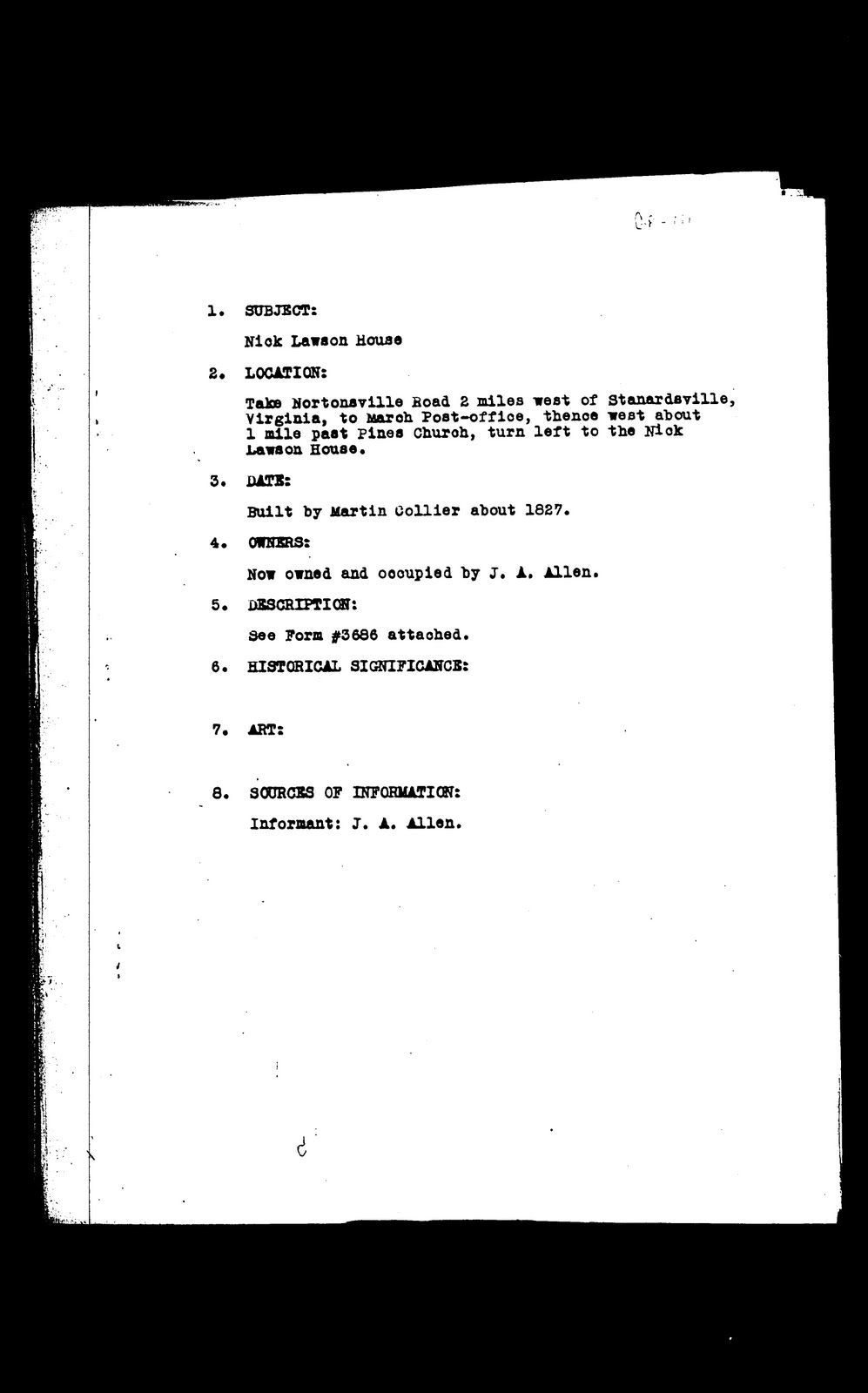
So, we know this is the Allen home, so who was Nick Lawson?? As we've posted before, John William Allen purchased, in 1900, 166 acres of land in Greene County. A portion of that deed is listed here:
This Deed made this Oct 15, 1900 between F.M. McMullan [?] hereinafter
described of one part and John W. Allen of the other part. Whereas
said F.M. McMullan & R.S. Thomas [?] in the suit of H.S. Collier vs
Lawson in Greene Circuit Court in pursuant of the decree entered in
the said cause at Nov term 1894 of said court made public sale on
March 13, 1895 of the Martin Collier Home Place of 166 acres 2 roods
13 poles of land.

As you can see, the land that was purchased was called the Martin Collier homeplace. As it turns out, a Nicholas Lawson married a daughter, Texanna, of Martin Collier. The H. S. Collier mentioned in the deed is most likely Hudson S. Collier, a son of Martin Collier. Apparently there was an issue with the purchase or transfer of the land between Nicholas Lawson and Hudson Collier that allowed John Allen to purchase it.
Some more digging into Nicholas Collier reveals that is his full name was John Nicholas Lawson. He was born in 1841 in Rockingham County. As it turns out, the Lawsons were neighbors with the Maidens. Nicholas Lawson's family is listed immediately above William and Sarah Maiden (parents of John T. Maiden and grandparents of Mary Clementine Maiden Allen) in the 1860 census. Nicholas then married Texanna Collier and moved to Greene County.
It seems obvious now that there the Lawsons, Colliers, Maidens and later Allens all were closely associated with and knew each other well. More research is needed to find out the reasons behind the court case that led to John Allen's purchase of the land in Greene County.
Tuesday, March 22, 2011
David Epperson Cemetery
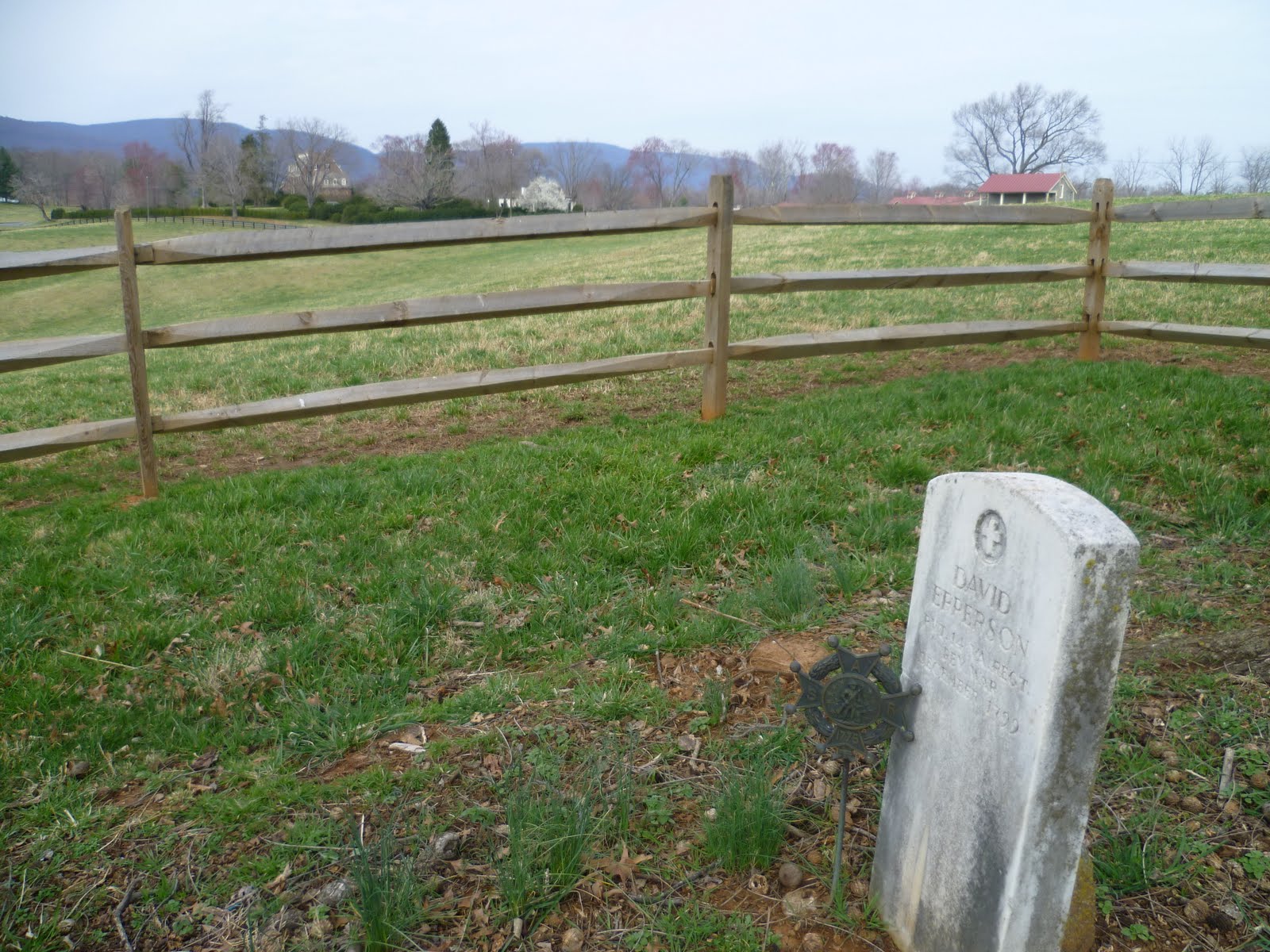
On Sunday, March 20th on our way home we made a detour south off of I 64 to Blue Ridge Farm off of Ortman Road near Greenwood in Albemarle County. Ortman road can be accessed from US 250 about 1.5 miles west of exit 107. The map at the bottom of the page shows the site.

Blue Ridge Farm is on the National Register of Historic Places. The main house was built in the mid 19th century by the Smith family. Randolph Ortman had the house enlarged in 1923. The work was done by renowned architect, William Lawrence Bottomly. The Epperson family seemingly owned land that at least partially makes up the current Blue Ridge Farm tract. In fact, the mountain just east of the current Blue Ridge Farm was once known as Epperson Mountain. John Epperson sold the land to the Durrett family in 1800 not long after his father David Epperson, Sr. died.
David Epperson was born in 1734. It is not known for sure who his parents were but it is thought that he was the son of John Epperson and Elizabeth and may have been born in New Kent County. In 1753, he married Hannah Thompson. David Epperson and family were patriots during the American Revolution. Both David Sr. and his son David Jr. enlisted and served. The elder David was in the 14th VA regiment. He also provided financial assistance to other volunteers who otherwise could not have afforded to leave their families. In 1776 his name appears on a dissenters petition for colonists who wished to be free of the Church of England.
Unfortunately, the younger David lost his life in the service of his new nation. He died at Valley Forge in 1777, leaving a young wife and children. It is from these young children that our line comes. David Epperson, Jr. married Judith Maupin. One of their daughters, Hannah Epperson, married Dillard Sandridge. Their child, Joel Maupin Sandridge had a daughter Elizabeth Sandridge who married Clifton Rice Wood Their daughter was Martha Frances "Fanny" Wood, wife of Algretus Rice Via. Another child of David Epperson and Judith Maupin was Anna. It is possible that Anna was a twin sister of Hannah. Anna married John Gardner. Their daughter, Sarah Harris Gardner was the wife of William Maiden. She is buried in the Maiden Cemetery in Rockingham County.
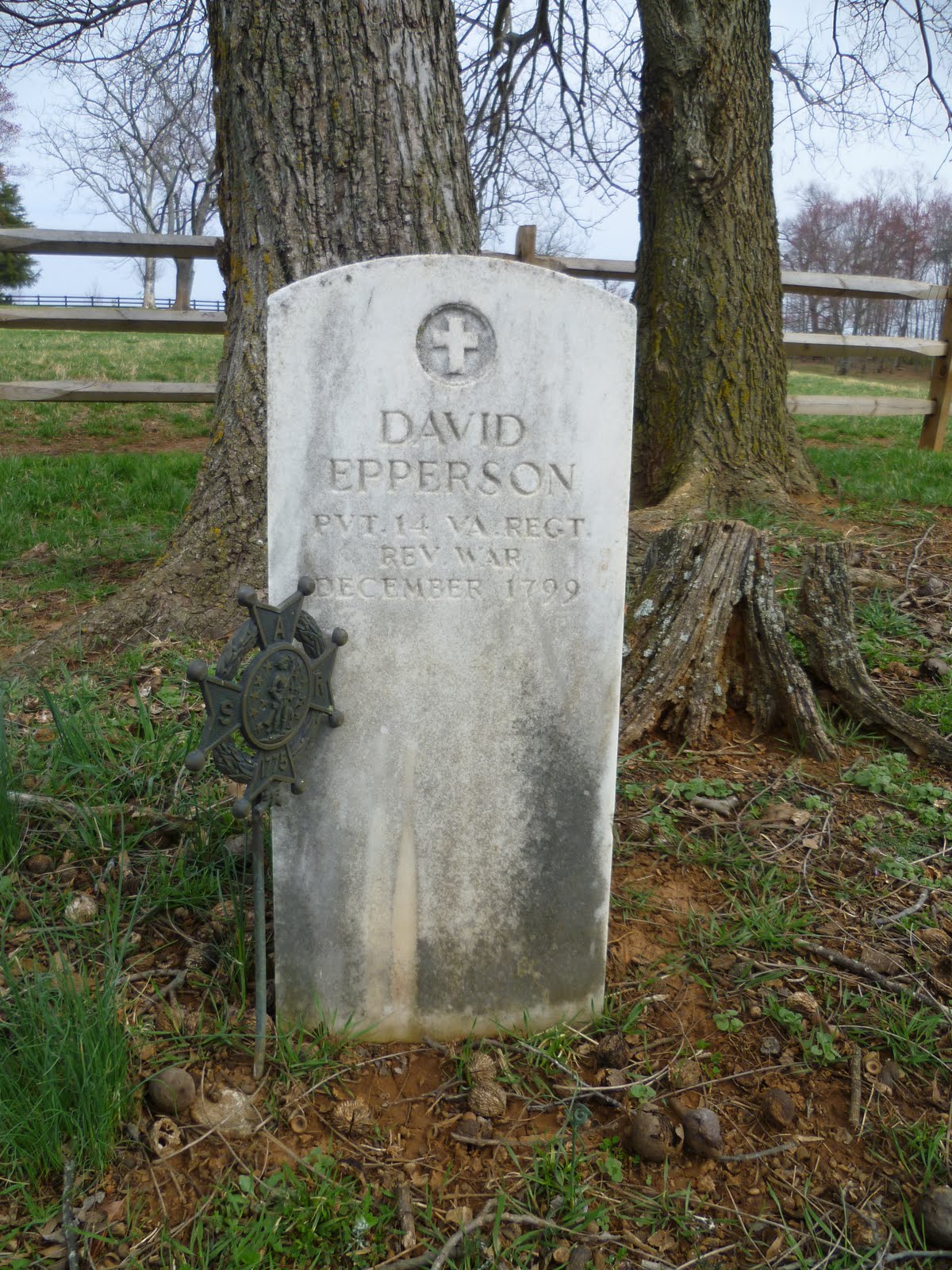
David Epperson, Sr. survived the war and died in late 1799. He was buried on his land and the cemetery remains to this day. Durretts are also buried there. The David Epperson marker is definitely not original. There is also a marker from the Sons of the American Revolution. The view from the cemetery is spectacular. We pulled up not knowing where to look for the cemetery, but a fenced in area was easily visible south of, and opposite the main house. I presumed this to be the cemetery. I happened across a farm hand who allowed me to drive the short way up the gravel road toward the cemetery. On the map below, the cemetery can be seen at the bottom center of the frame. By zooming in, you can easily make out the fenced in area that contains the cemetery.
View Larger Map
Monday, November 22, 2010
Return to the John A. Via Cemetery
 On October 18, 2010, after leaving the Allen farm, we went back to the John A. Via cemetery in search of the remains of the home which we'd heard were nearby.

We parked the car at the same gate and climbed over. It was much less muddy this time, which made things easier! We walked immediately up to the cemetery and went through the gate. We found that the cemetery had been worked on recently. The Virginia Via reunion is held Columbus Day weekend and one of the reunion activities is to clean up Via family cemeteries, including this one. The John A. Via stone had been repaired and some brush had been cut back. The sign by the gate had been taken down for repairs but was due to be replaced soon.
After exploring the cemetery we moved up road behind it, just to see where it went. We had some information that described approximately where the house was, but wanted to explore all we could. Up this road we found bones of cattle and an old dozer. It seems that the dead cattle were carried up here to be butchered, but we're not sure. The road continued up the hill but we didn't follow it all the way. I believe it goes to the top of the mountain.
 We returned to the cemetery and then set off to the west across the open pastures. We headed straight towards the western corner of the fields, where we had seen something that could have been the remains of a house on Google Earth. This along with our other information from Via family researchers turned out to be correct and we came across the remains of the home without having to really search at all.
The first thing that stands out is the old metal roof that covers much of the remains of the house. The wooden boards have fallen into the cellar and at a glance appear jumbled randomly. If you look closely though you can make out what was once the floor and the walls and you start to see how the house was situated.

We began to explore around the house and noticed that the nails were made by hand. This is a sure sign that this was a very old house. We also discovered some non-native plants, probably planted by the Vias growing around the house. There were also old bottles, and pieces of ceramic (see above). I'm not sure how old these might have been.

There is still a lot we don't know about the house. When was it built? When was it abandoned? When did it collapse? We were told by one source that there used to be a small village in the area, but that everyone moved out during the depression.
Enlarge the map below to see the relative locations of the cemetery and house.

 This calf kept following Grandma! We had to shoo it away. Perhaps it was her red sweater tied around her waist. Check out its shifty eyes!
Tuesday, November 16, 2010
Visiting the John Allen family farm

On October 18, we had the opportunity to visit, and walk the grounds of the John William Allen family farm in Greene County. We were greeted by Tom Allen and his son Brad. Tom is the son of John Arthur Allen who in turn was the son of John William Allen. They showed us where the old house used to be. It stood directly behind the modern home at the front of the parcel, now occupied by Shelvia Jean Allen. All that is left is the well. The well once was part of the back porch. The picture to the right shows a couple of views of the house. The top photo shows construction of the modern house taking place directly in front of the old. Tom also mentioned that he was in possession of the still once owned by his grandfather. The still's top was removed when prohibition was enacted and from then on used to make apple butter. Hilda Allen recounted some memories of the old house. She particularly remembers the smells associated with visiting her grandparents. She recalled the smells of bread that Mary Maiden Allen would bake, and also of coffee, which Mary apparently drank frequently.

After Tom and Brad had to leave, we went down the hill below the farm and looked around the area where Allen family reunions were once held. The area has overgrown some, but the spring house is still visible. In the past, during reunions, tables were set up here where everyone sat and enjoyed a large meal. As a child, I remember playing in the creek and seeing the watermelons floating in the spring house to keep cool. We also saw a large pile of stones across the stream. It looks to be a particularly large example of a stone pile made from the clearing of a field. We do not know when this was done or who did it.
From the bottom of the hill we could look up at the old barn. We weren't sure exactly when it was built, but we are sure it was there during John William Allen's time. In viewing the barn from below we saw that this was near the spot where a photo was taken of my great grandfather Russell Allen with his brother George. See the photos below.
 |  |

We wandered back across the land to another old building that has no doubt been around since the time of John Allen. Hilda Allen remembered this being where the sheep were kept. It is a very interesting building, looking almost like a home. It sits at the southern end of the property. Just north of this building was the spot where softball games were held during the reunions.
We next headed across the property to check out a small cemetery that Tom Allen had mentioned to us. This sits is to the east of the barn on land now owned by Stephanie Allen Deal. The deeds to the property describe the land as the old Martin Collier home place and mention a Collier family burial ground (see older blog posts) and we believe the two small field stones we found may indeed mark this Collier burial ground. Enlarge the photo below to see the two field stones. It is possible these mark the graves of the aforesaid Martin Collier and his wife.

All in all we had a great time exploring the John William Allen family farm and we hope to do it again soon. It is in a beautiful setting with views towards Shenandoah National Park, Bacon Hollow and Powell Gap. It is quite possible that John William and Mary Maiden Allen brought their family from Rockingham to this new farm in 1901 by passing over Powell Gap and through Bacon Hollow. The farm house would have faced almost directly towards the spot that Johnnie Shiflett grew up with his mother Frances, almost as if it was looking back to the past, just as we had been doing on that day.

The Google Map below shows the barn (left) and modern house (right). Just south of the modern home is the site of the original John William Allen house.
View Larger Map
Friday, September 3, 2010
Caroll County and Rockingham/Greene County Connection?
Hey Stephen,
I'm excited about going back out to Frances Shiflett's property for another hike. Have you tried contacting anyone that was a part of the documented hike to the Hill/Shiflett/Powell cemetery back in 2000 (per the H/S/P web site: http://www.mycemeterysite.com/hsp/hsp2index.htm)? I'd bet those people could provide some tremendous insight into the property and its history.
I was just looking through the list of burials in the Evergreen Church Cemetery here: http://www.mycemeterysite.com/evergreen/evrgrnindex.htm, and I found an interesting name on one of the stones. Take a look: http://www.mycemeterysite.com/evergreen/images/shiflet/floyd_mildred.JPG.
What do you think the chances are that Floyd Allen Shiflett could have been named after Floyd Allen of Carroll County (executed in 1913)? Based on the birth date of Floyd Allen Shiflett's wife, I'd put him being born right around 1900...Floyd Allen of Carroll would have been close to 50 years old at that time. I know it's a stretch, but could there have been some kind of connection between the Carroll County Allen's and the folks in the mountains of Rockingham and Greene Counties back in those days? Is it possible that they were running alcohol up and down the mountains of western Virginia? It is known that illegal distillers were very common around the turn of the century in Carroll County, VA. And it is suspected that the Allen family...particularly Sidna Allen...earned a pretty good living producing and distributing illegal alcohol.
Could this 'trade route' be the link to why/how Frances Shiflett ended up going from Carroll County "back to" Rockingham County, as George Allen's account states?
Just a thought. Let me know yours.
--Russ
Thursday, August 26, 2010
Theory on Frances Anne Shiflett
Okay, so all this discussion on John Allen's land purchase in 1900 brings me to thinking about where in the world Frances Anne Shifflet (his mother) came from. I'm going to try to coherently express my current theory below. Your comments/thoughts/questions would be appreciated.
To me...it all seems to be coming together, little by little. We don't have proof of a lot of things, but I can't help but fall back on what I would say are our "best bets". If we always waited on proof for everything, we'd never get anywhere. We have to use our "gut instinct" and our imagination at times. So here goes...
The Allen family story says Frances Shiflett was 1/2 Cherokee. Until recently, I've largely discounted this theory. But at this point, I'm coming to believe it. Here's my theory:
From John William Allen's deed, and what we've discovered through it, I have no doubt that he knew of the availability of the Martin Collier Home Place through his neighbor on the hill, Solomon Shiflett...Martin Collier's son-in-law (husband to Frances Collier, daughter of Martin Collier). That is so cool.
So my "gut" is now telling me that Frances Shiflett was the daughter of a female Native American (Wendell Allen insists that his Dad, Russell, told him that his Grandmother Shiflett was 1/2 Cherokee) and a white mountain man.
Her dad was very possibly Stephen Shiflett, father of Solomon Shiflett (mentioned above), who had a propensity of siring many children, and is known to have done so through at least two different woman. As I mentioned above, we know that Stephen, and later his son Solomon, were neighbors of Frances Shiflett when she lived on her 66 acre property between 1866 and her death in 1898. Stephen was close to 50 years old when Frances was born. Stephen's oldest son (in our records), Edmund Shiflett was around 22 at the time of her birth, so it is quite possible that one of Stephen's kids (another son, Thomas Shiflett, would have been about 18 at the time of her birth) could have sired Frances, making Stephen her Grandfather (and Solomon her Uncle, only about 5 years older than she was).
The Native American idea helps to explain why Frances was so much further south--living with Carr and Temple Allen in Carroll County, VA, as the family story goes--when she became pregnant. This may also explain why she ended up essentially buried alone...not claimed by the Cherokees and never fully claimed by the white side of her 'family'.
The Native American idea helps to explain why Frances was so much further south--living with Carr and Temple Allen in Carroll County, VA, as the family story goes--when she became pregnant. This may also explain why she ended up essentially buried alone...not claimed by the Cherokees and never fully claimed by the white side of her 'family'.
The Cherokees are known to have lived largely in the mountains of Tennessee, western North Carolina, Kentucky, Georgia and other areas in the south. There's not much mention of Cherokees in Virginia, but it wouldn't be surprising at all to find a few in the western mountains of Virginia by the early 1800's.
So let's say Frances' Cherokee mother was impregnated by Stephen Shiflett (or one of his older sons) around 1823 (the year it is believed that Frances was born). This white man wouldn't have stuck around to have anything to do with her. So the mother probably did all she could to raise the girl on her own. Things were extremely difficult at the time for the Cherokee. The white settlers wanted them off what they felt was their land. President Andrew Jackson implemented the removal of the Native Americans with the passage of the Indian Removal Act of 1830. The mother would most likely have stayed with her tribe to raise the young girl, for the support they would have provided. But her tribe was probably being pushed out...eventually pushed to the barren lands of Oklahoma.
But at some point, for whatever reason, Frances ended up being separated from her mother. Perhaps it occurred when the Cherokees were finally 'herded off' in 1838 (when Frances was a young teenage girl) in what is known today as the "Trail of Tears". But for some reason (perhaps because she was half white) Frances stayed behind in Virginia.
Perhaps people like the Allens of Carroll County, showed sympathy for her and took her in? Now the family story says that she worked for the "wealthy" Carr and Temple Allen as a maid. But this part of the story doesn't hold-up real well, due to the fact that records shows that Carr and Temple Allen of Carroll County, VA were far from people of means. But she could certainly have done more than her share of work around the house, feeling as though she owed it to the Allens for giving her a place to stay.
But what is very interesting is that, through my research efforts, I have discovered that Carr and Temple Allen's youngest son was named Andrew Jackson Allen (and, according to U.S. Census records, he occasionally went simply by "Jackson"). This boy was roughly 18 when it is believed that John William Allen was conceived (Frances would have been about 20 at the time). I believe, with confidence, that this boy is the "Jackson Allen" that, according to family story, Frances Shiflett told her son, little Johnnie Shiflett, was his father (whether it actually was his father is still up for debate, and will hopefully be proven through DNA testing some day).
According to family story, Frances Allen went north to Rockingham County, Virginia after becoming pregnant around 1848 to 1850. I suspect that the Allen family forced her to leave, after discovering that she was pregnant with their son's baby. The family story even suggests that she was paid-off and told to get out (but again, this doesn't hold-up real well when one realizes that the Allens had very little at that time). Or maybe she just chose to leave to escape the embarrassment of being an unwed mother. Either way, I suggest that she decided to head north to find her "father"...hoping that he might support her in her difficult situation.
I then believe that she ends-up working for Stephen Shiflett (and maybe even living with him) on his mountain side farm for roughly 16 years, before finally having enough money to put a deposit on the 66 acres she purchased for $80 1866 (keep in mind that we know it took her roughly 20 years to finally pay-off that purchase).
Subscribe to:
Posts (Atom)